There's a phrase that keeps ringing,"we meme to survive"
A young Kenyan said it almost casually during one of our foresight labs. But sit with it for a moment. It's not a joke. It's a philosophy. It's a survival strategy wrapped in internet culture. And it tells you more about the future of Africa than most economic forecasts ever will.
Over the past months, the Reelanalytics research team spent time with more than 80 Kenyan youth and caregivers, Gen Z (ages 16–25) and the parents of Gen Alpha not to study their problems, but to decode their signals. What we found challenges what we think we know about young Africans.
The Old Story Is Wrong
For decades, Africa's youth have been framed as a "demographic dividend", a population bulge of potential waiting to be unlocked by the right policy, the right investment, the right approach.
That framing is broken.
It positions young people as passive beneficiaries of someone else's vision. It asks: what do they need? when the more urgent question is: what are they already building?
When you actually sit with these young people, not in boardrooms or policy briefs, but in foresight labs and digital diaries and late-night WhatsApp threads, you see something completely different. You see architects.
Kenya's Gen Z isn't waiting for formal systems to work. They're building parallel ones. Here's how;
The Smartphone Is Their Infrastructure
For young Kenyans, the smartphone is simultaneously a classroom, a marketplace, a therapy room, and a political organizing tool. All at once.
YouTube and TikTok have become parallel education systems, not supplements to school, but often replacements. When "load-shedding ruins tuition," as one participant put it, and the formal system fails, they don't stop learning. They adapt.
M-Pesa and WhatsApp have fused into community safety nets that blur the line between friendship and finance. Online hustles from micro-influencing to e-commerce, have emerged not as side gigs but as primary income strategies in a job market that isn't catching up.
This isn't just resourcefulness. It's systemic redesign in real time.
By 2030, digital equity will rival healthcare and education as a national policy priority. The question isn't whether governments will acknowledge this. It's whether they'll do it before or after Gen Z builds the solutions themselves.
Identity Isn't Inherited. It's Built.
One of the most striking findings from our cultural research was how differently these young people approach identity compared to every previous Kenyan generation.
For Gen Z, tradition is not a fixed inheritance. It's a living text, something to be remixed, not just received.
They speak in Sheng, a hybrid of Swahili, English, and indigenous languages that dissolves ethnic boundaries and creates new codes of belonging. They're creating art and music that merges indigenous aesthetics with contemporary ones. Young women are rewriting the terms of femininity through sheer refusal: "Marriage hubamba mafala." ("Marriage isn't fulfilling.") "Pregnancy will kill me."
These aren't just provocative statements. They're acts of self-authorship. They're young Kenyans refusing to have their identities handed to them.
Kenya's cultural future isn't about preserving heritage or abandoning it. It's about adaptive traditionalism a plural modernity built on remix, consent, and co-ownership. That's a profound shift, and it's happening whether institutions are ready for it or not.
Civic Life Has Moved Online, And It's Not Moving Back
"Voting counts, but arranging ourselves is what matters"
That quote came up repeatedly in different forms across our research. But here's what's interesting: the cynicism about formal politics doesn't translate into disengagement. It translates into alternative engagement.
#EndFemicide. #OccupyParliament. These aren't just hashtags. They're organizing frameworks. They're new civic architectures. Credibility has shifted from elected officials to peer-driven issue networks and Gen Alpha is watching all of it through caregivers' screens, absorbing civic participation as a natural part of life.
The governments that will earn legitimacy with this generation won't do it through slogans. They'll do it through authenticity, civic engagement, participatory budgeting, and transparency. Governance has to become a co-creation project or it will become irrelevant.
The Three Tensions That Define This Generation
After synthesizing everything we heard and observed, three core tensions emerged that shape the daily experience of young Kenyans:
- Access vs. Overload. Digital connectivity is a lifeline, but it's also a source of anxiety, misinformation, and exhaustion. Being always-on has a cost that nobody is adequately measuring.
- Tradition vs. Innovation. Generational values are evolving faster than institutions can track. Families, schools, and policymakers are often operating on assumptions about youth that are already obsolete.
- Outrage vs. Impact. Young people are paying attention to everything. They're angry about information asymmetry. But continuous activism without systemic reform risks burning people out. Sustained change requires systems that reward participation with actual results.
These tensions aren't problems to be solved. They're the productive friction that's generating new ideas, new identities, and new institutions.
Here's the concept that emerged most powerfully from our research, the one that has broadest implications for how we understand Africa's future:
The Imagination Dividend.
The old framing was about population. More young people = more economic potential. It treated the youth as a quantity to be managed.
The new framing is about density of imagination. It's about young people's capacity to prototype futures, to see what doesn't exist yet and build toward it, often with very little. A smartphone and a WiFi connection and a community of peers and an idea can generate an enterprise, a movement, a cultural shift.
Africa's next competitive advantage isn't demographic. It's creative intelligence and ethical innovation.
The next billion voices aren't waiting to be heard. They're already expressing themselves, in memes and building micro-enterprises, in protest songs and participatory budgeting proposals, in foresight labs where young people in Kisumu map what Kenya 2040 looks like from their perspective.
What This Means If You're Paying Attention
For brands: You cannot advertise your way into trust with this generation. They know the difference between a campaign and a genuine partnership. Co-creation ecosystems, not marketing funnels, are the path forward.
For NGOs and development organizations: Stop designing programs for youth and start designing with them. Establish youth foresight labs. Turn imagination into community innovation infrastructure.
For policymakers: Digital citizenship education isn't a nice-to-have. It's foundational. Mental well-being embedded in youth development frameworks isn't soft, it's strategic.
For educators: The classroom is competing with TikTok and YouTube and M-Pesa and a thousand other teachers. Creative, mobile-first, problem-solving pedagogy isn't a trend. It's the only thing that will stay relevant.
The Future of Africa Is Not Just Young. It Is Consciously Designed.
What struck the most, after all the interviews and foresight labs and digital diaries, was this:
These young people are not naive optimists. They see the structural failures clearly;the corruption, the infrastructure gaps, the systems that weren't built for them. They're not waiting for those systems to fix themselves.
They're building in the gaps. They're designing the alternatives. They're prototyping futures.
Kenya's Gen Z and Gen Alpha embody the shift from inheritance to invention from receiving systems to redesigning them.
The next billion voices aren't a wave to be managed. They're a creative infrastructure to be partnered with.
And if the institutions, brands, and governments of today don't figure that out soon, they'll find themselves watching from the outside as the next generation builds the world without them.
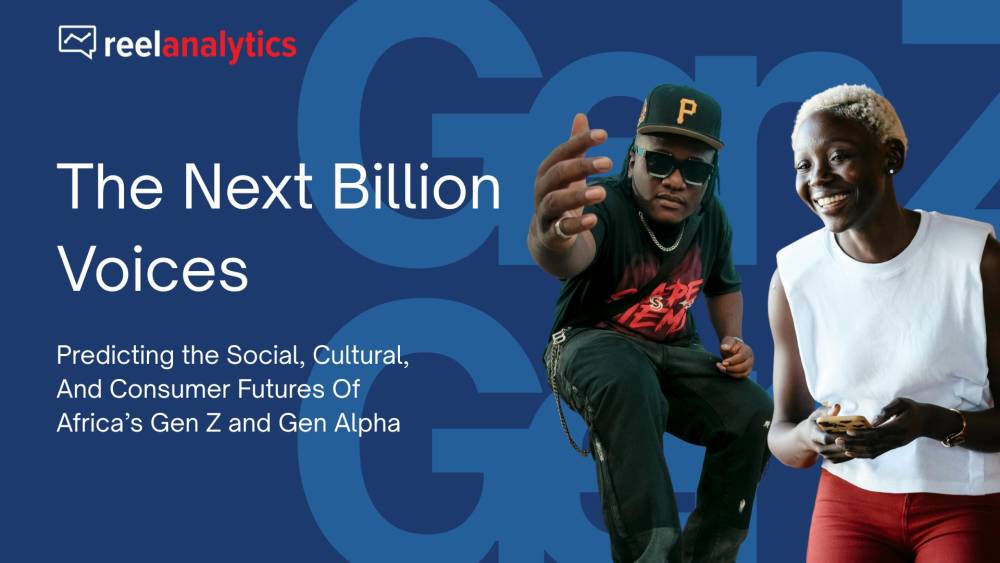
This post draws from The Next Billion Voices: Predicting the Social, Cultural, and Consumer Futures of Africa's Gen Z and Gen Alpha, a full foresight research paper by Reelanalytics (November 2025).
The complete report includes:
- Full methodology and analytical framework across four research stages.
- Detailed findings on digital empowerment, cultural identity, civic awakening, and well-being.
- Signal mapping and convergence analysis across five Kenyan cities.
- The 2035 Foresight Outlook across social, cultural, and consumer futures.
- Strategic implications tailored for brands, NGOs, policymakers, and educators.
- Expert corroboration from education, early childhood development, and digital strategy specialists.
Download the full report.